`
Update 19/10/2025: The companies mentioned in this article have performed well, with Aster DM Healthcare gaining over 100% from its 2024 value. I have also expanded my positions in Fortis Healthcare and Biocon, which together have achieved a cumulative gain of +94.6% over the initial entry value. In contrast, the consumer sector holdings have delivered a modest +10% return since 2024
This approach may come out unconventional, but it highlights a significant insight: the data you need is always around you, and understanding it can work in your favor.
In May 2023, after five years, I returned to India for a short visit. As any Indian would, my first thought was to spend my vacation money in my home country. So, why not the Andaman Islands?
After some last-minute planning for a solo trip, I was on a flight to Port Blair, connecting via Delhi. Onboard were two crying infant twins and their mother, doing her best to maintain peace within the cabin (god bless her soul). I finally arrived in Delhi.
Everything seemed different—the stark contrast, the airport traffic, seemed bigger and faster than I remembered. What used to be just an immigration counter on one side of the airport had expanded to the opposite side as well. After checking out from the international terminal, I had a long layover for my domestic connection. What I dreaded at the moment became an opportunity in hindsight.
Before we get there, let me share a bit about myself. I’m an electrical engineer who started his career in railway construction. One of my first assignments was to assist an integration engineer in counting cars at a traffic light junction. This small exercise might have seemed silly to bystanders, but it’s one of the parameters used to design traffic systems effectively. This habit stuck with me—if I have free time in a public space, I count, I observe.
So there I was with time to spare. Like anyone else with a bit of credit card “privilege”, and regret of not using it for half a decade, I decided to head to the lounge. What I observed was a bustling scene. What used to be a ghost town at the corner of the domestic airport food court was now packed, with a line outside, everyone trying to swipe their card. This was an opportunity. This is what I did best—I counted.
Why is counting here important? This Individual represents a unique sample size, they are the top earners within the country often called as India 1, with access to credit line. A portion of the hardworking middle class pays most of India’s direct tax. These citizens represent 3% of India’s population but contribute at least 50% of the tax collected in the whole country.(Reference)
Observation 1:
Out of a sample size of 100, 71 were obese or morbidly obese (those with a body fat percentage above 25%), sadly including many children. Putting political correctness aside, this was a very new insight for me. This is from a country predominantly vegetarian, and lucrative market that Kentucky Fried “Chicken” has an all-green vegetarian menu cooked in a dedicated vegetarian kitchen. With the breakfast buffet line open at the lounge, one could gain great insight into people’s eating habits. Many were opting for diet soda options, which I found fantastic, but at the same time indulging in oil and carb-heavy options at the breakfast buffet. Quality protein options other than a boiled egg or Masala omelet were non-existent. The next “best thing” available was Boiled Sausages and Fried bacon. ( Reference 2)
Observation 2:
Walking towards the gate, knowing I had a 4-hour flight to Port Blair and another 2-hour ferry ride to my destination , I knew the only way I could get there was if I got caffeinated. Soon, I found myself in the biggest line at Starbucks at an airport. I have never seen such a line at Starbucks in the Middle East, where it’s practically non-existent. With time to kill, I stood in line for 45 minutes, amazed at this phenomenon. This later turned into bill shock, as I paid more for coffee than I would in the Middle East. This was extremely surprising to me, yet more fascinating. Why? This wasn’t the case a decade ago. In a country where the home-grown premium coffee brand Café Coffee Day went into ₹7000 crore debt and was almost on the verge of bankruptcy, setting the founder on an unfortunate path, here were people not fazed by the idea of indulging in premium coffee that cost as much or more than international prices. ( Reference 3 )
Insights:
From these two observations, I understood the spending patterns in India have changed significantly. On one side, this signals prosperity, which is a good. However, with prosperity comes indulgence. Extreme newfound indulgence always comes at a cost. Some might view this as grim, but it’s human behavior. It’s a pattern not just limited to India but a global phenomenon. It is what it is. When I returned I predictive guessed to invest in the following companies below.
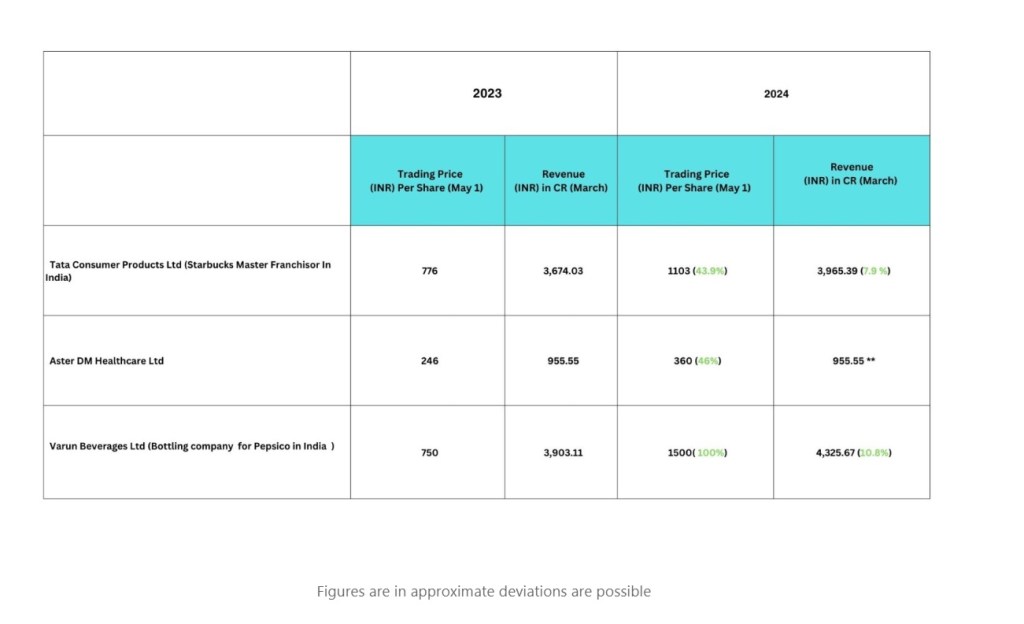
I believe that with these trends, the hospital and consumer sectors will continue to climb as we move forward. I will be expanding positions in my personal portfolio within this sector in the coming years (with due diligence, taking care of the fundamentals to the best of my understanding).
But why isn’t it rogue to be this bullish specific data point relatively small sample size? Absolutely , in this case , there hard data backing it. Unlike in other countries, public healthcare doesn’t fall in the radar for the highest tax-paying citizens who will not avail themselves of the free government hospital due to existing constraints of the system. It will take years, or even decades before it reaches the standards of private healthcare. Don’t get me wrong; India does have some of the brightest and most talented doctors within the public sector, but infrastructure & ease of access, unfortunately, isn’t its strong suit.(Reference 4) One might say this is capitalizing on the pain of others; that is far from the truth. As India develops the overhaul of medical infrastructure is an inevitable necessity. Further, It’s also basic supply and demand. There is a segment of consumers that wants quick service, mover over they can also will to pay for it.The business model specialty hospitals is capital intensive, giving the upper hand existing big players.
This can be one of reasons I speculate Aster DM Middle east based Indian Publicly traded chain of hospital decided separated/sold the Middle East division from the Indian group of hospitals as they felt the Middle East division was weighing on the overall performance of the Indian Business . The executive decision to sell/separate the Middle Eastern wing of the business was widely supported, awarding each of its shareholders 118 rupees as a dividend for each share of the face value of 10 INR (108%). Further, Aster India Dm ‘s almost all of the promoter shares currently pledged to further expand the business within India. It sounds like a flight risk to a pessimist or an absolute bet by a visionary in the field to an optimist; I believe in the latter. With his track record in the Middle East, the founder Azad Moopan and his board expanded a small clinic into an international hospital chain, they might be seeing something we are not. ( Reference 5 )
What makes it even more concrete that private hospitals will see a boom in the coming years is the trend across various sectors. For instance, the FMCG sector in India has been expanding consistently, particularly the packaged food industry, which is projected to reach an $86 billion market by 2029, according to the Indian Food Processors Association. There is a strong government push to bring more jobs within this sector. Processed food is not bad, but it is relatively new to India, where once everything was cooked at home. The guidelines are still not as robust as in Europe. Maybe it’s mere coincidence that the rate of non-communicable diseases like diabetes and heart-related problems has been steadily growing since 1996-2016. With access to multiple options and convenience-friendly foods, it’s possible for many to indulge in this new form of consumer freedom. The question is, which sector of society and how many of the 1.3 billion population are affected?
One may argue that the supply of doctors is already a major factor for hospitals. Adding to this, discrepancies in the National Testing Agency that conducts exams for inducting and training new doctors, and new policies and tighter scrutiny on practitioners with valid foreign certifications to practice in India, will further constrain the supply of existing practitioners. Hospitals will need to increase spending on acquiring and retaining existing practitioners. Won’t this reduce their revenue as they won’t be able to expand as much? Maybe, or on the contrary. If demand climbs the way it looks, customers will be bound to spend more eventually. Even in the worst-case scenario, the price of the same level of service will rise.
One often overlooked factor is India’s relatively young workforce, averaging 28 years old. As the current population ages, the load on the existing medical system is bound to increase with time, presenting blooming opportunities within the healthcare sector.
This isn’t new. Human nature, when observed, has patterns within it. This has happened before in the US after World War II. Will the pattern repeat? Only time will tell if, with all the information available, India can navigate it better or if history will repeat itself.
What do you think ?
This is not investment advice, please use your due diligence. This article is not against or for a political party or local or for or religious body. Everything mentioned in the article is speculative and anecdotal in nature.
 Aswin Paraprath